The notion of amortization arises from the following…
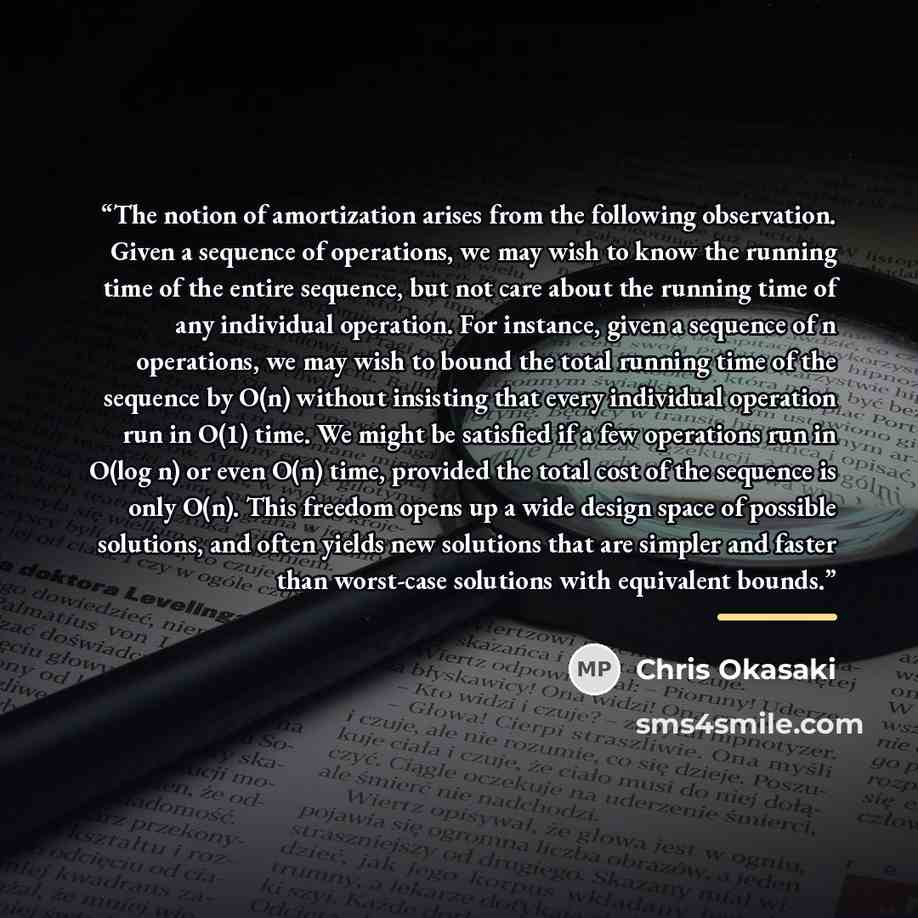
““The notion of amortization arises from the following observation. Given a sequence of operations, we may wish to know the running time of the entire sequence, but not care about the running time of any individual operation. For instance, given a sequence of n operations, we may wish to bound the total running time of the sequence by O(n) without insisting that every individual operation run in O(1) time. We might be satisfied if a few operations run in O(log n) or even O(n) time, provided the total cost of the sequence is only O(n). This freedom opens up a wide design space of possible solutions, and often yields new solutions that are simpler and faster than worst-case solutions with equivalent bounds.””
About This Quote
This interpretation was drafted with AI assistance. It is one reading of the quote, not the author's own explanation.
Amortized analysis evaluates total cost of a sequence of operations, allowing occasional expensive steps as long as overall cost stays linear.
In simple terms: It looks at average cost over many operations, not each one.
Key Takeaway
Use amortized analysis to design efficient algorithms.
Themes
computer science
algorithm analysis
efficiency
complexity theory
design patterns
Mood
technical
analytical
educational
Type
educational
technical
When to use this quote
- data structures
- software engineering
- performance optimization
- educational material
Key Concepts
Amortized analysis
potential method
aggregate analysis
Questions to Reflect On
- When is amortized analysis appropriate?
- How does it compare to worst‑case analysis?
A Different Perspective
May not capture worst‑case performance needed for real‑time systems.