“Also, when one thoroughly analyzes a continuum on the seeming level, [one finds that] the utpala at the time when it is… — Karl Brunnholzl Copy Share Image
“Not only can nobody deny the appearance of mere consciousness whose nature is other-dependent and not affected by the flaw of conceptions… — Karl Brunnholzl Copy Share Image
“Nagarjuna's Rebuttal ofObjec- tions says: If there were anything to be observed Through direct perception and the other instances [of valid cognition],… — Karl Brunnholzl Copy Share Image
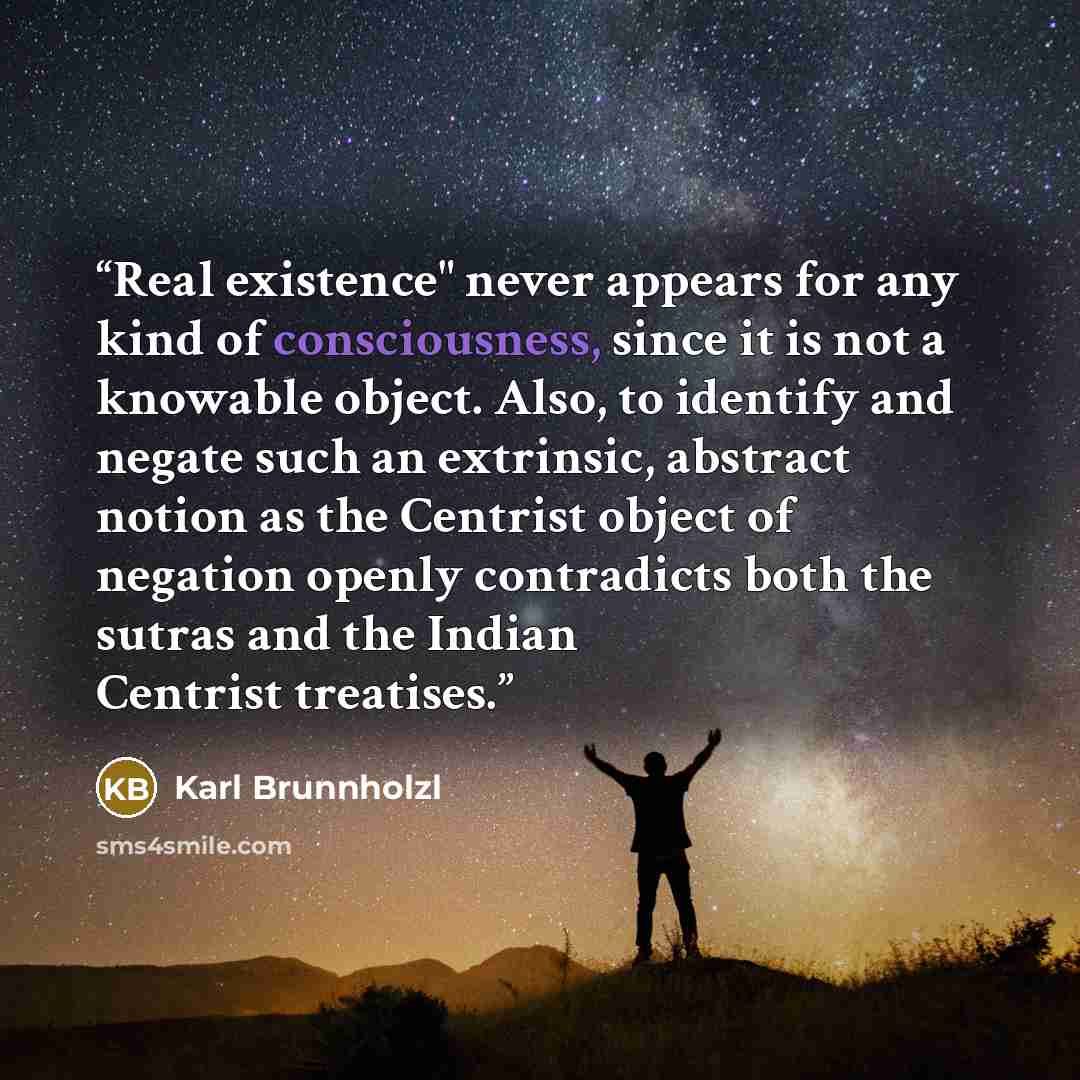
“Real existence" never appears for any kind of consciousness, since it is not a knowable object. Also, to identify and negate such… — Karl Brunnholzl Copy Share Image
“You might wonder, "Why is the ultimate not the sphere of cognition?" Because it is asserted that cognition, or consciousness, is the… — Karl Brunnholzl Copy Share Image
“For, although the Buddhas themselves do not cling to such notions as purity and impurity or truth and untruth, they assist the… — Karl Brunnholzl Copy Share Image
“For this expanse of dharmas just as it is, the conventional term "ultimate reality" is used. You might object, "What do you… — Karl Brunnholzl Copy Share Image
“Asanga's commentary elaborates on this verse: The [ground consciousness] is difficult to understand, since it is not [taught] on the lower levels… — Karl Brunnholzl Copy Share Image
“From all of these sources, it should he very clear that such Yogacara terms as "mere mind," "mere cognizance," and "mere consciousness"… — Karl Brunnholzl Copy Share Image
“Therefore, everything is the illusory magical display of one's own mind. It is appearing yet delusive, and delusive while appearing. Thus, all… — Karl Brunnholzl Copy Share Image
“However, despite their synthesis of Yogacara and Centrism, all Yogacara-Madhyamikas, such as Jnanagarbha, Santaraksita, Kamalasila, and Haribhadra, unanimously refute the notion of… — Karl Brunnholzl Copy Share Image
“Pawo Rinpoche comments that, in Tibet, the intention of the lineage of profound view is usually explained as self-emptiness, that is, as a nonimplicative… — Karl Brunnholzl Copy Share
“One may wonder, "What is seeing the ultimate?" It means that all phenomena are not seen.” — Karl Brunnholzl Copy Share
“Hence, [emptiness] is also not an object of [something like the] cognition of Buddhas, because they do not have [such a thing as] cognition.” — Karl Brunnholzl Copy Share
“Here, master Bhavya states [this as] the main argument, and then he formulates four autonomous reasons as the means to prove the subject property.… — Karl Brunnholzl Copy Share
“In general, every negation must depend on the rejection of an affirmation or proposition, which means that emptiness as a nonimplicative negation is not… — Karl Brunnholzl Copy Share
“Therefore, everything is the illusory magical display of one's own mind. It is appearing yet delusive, and delusive while appearing. Thus, all of it… — Karl Brunnholzl Copy Share
“In brief, the very quintessence of all meditative concentrations of both the sutras and the tantras of the great vehicle is to see, through… — Karl Brunnholzl Copy Share
“The Ornament of Sturas says: Therefore, liberation is only the exhaustion of mistakenness.” — Karl Brunnholzl Copy Share
“Not only can nobody deny the appearance of mere consciousness whose nature is other-dependent and not affected by the flaw of conceptions of a… — Karl Brunnholzl Copy Share
“And so-in what amounts to a deeply ironic twist of fate-Candrakirti was posthumously awarded highest honors from an orthodox scholarly tradition that could sustain… — Karl Brunnholzl Copy Share
“As for the notion of Buddha nature, there is no reifying interpretation of it in any of the texts of the lineage of vast… — Karl Brunnholzl Copy Share
“Whether on the level of no analysis or with analysis, it is never justified that mind exists whereas form does not exist. Under analysis,… — Karl Brunnholzl Copy Share
“To reiterate, no such divisions existed in India. Some Tibetans, such as Mikyo Dorje and Pawo Rinpoche, refused to follow either of these later… — Karl Brunnholzl Copy Share
“If the mere nonexistence of attention and mental engagement is taken to be "nonattention" and "mental nonengagement," it is to be analyzed in what… — Karl Brunnholzl Copy Share
“However, neither victory nor defeat comes about through the words of the other party alone. This means that if we speak the truth without… — Karl Brunnholzl Copy Share
![“Also, when one thoroughly analyzes a continuum on the seeming level, [one finds that] the utpala at the time when it is seen and the utpala at the time when it is [conceptually] apprehended are different entities. Furthermore, the sense consciousness that experiences it and the apprehending…” quote by Karl Brunnholzl](https://sms4smile.com/q/img-quotes/d59/karl-brunnholzl-4600_time_also-when-one-thoroughly-analyzes-a-cont_2151479.jpg)
![“Not only can nobody deny the appearance of mere consciousness whose nature is other-dependent and not affected by the flaw of conceptions of a body with form and so on, but those who make any such [denial] only invalidate themselves by perception and such.” quote by Karl Brunnholzl](https://sms4smile.com/q/img-quotes/52d/karl-brunnholzl-4600_consciousness_not-only-can-nobody-deny-the-appearance_199293.jpg)
![“Nagarjuna's Rebuttal ofObjec- tions says: If there were anything to be observed Through direct perception and the other instances [of valid cognition], It would be something to be established or rejected. However, since no such thing exists, I cannot be criticized.” quote by Karl Brunnholzl](https://sms4smile.com/q/img-quotes/393/karl-brunnholzl-4600_perception_nagarjuna-s-rebuttal-ofobjec-tions-says_2560713.jpg)
![“Asanga's commentary elaborates on this verse: The [ground consciousness] is difficult to understand, since it is not [taught] on the lower levels of the teachings, since it abides as bearing the characteristics of the seeds of the [six] operative consciousnesses, and since it does not abide…” quote by Karl Brunnholzl](https://sms4smile.com/q/img-quotes/c40/karl-brunnholzl-4600_poetry_asanga-s-commentary-elaborates-on-this-v_616422.jpg)
![“Therefore, everything is the illusory magical display of one's own mind. It is appearing yet delusive, and delusive while appearing. Thus, all of it is contained in the body, and the [body] is again contained in the mind. As for the mind, it has no color and no shape. It is natural luminosity that…” quote by Karl Brunnholzl](https://sms4smile.com/q/img-quotes/8f8/karl-brunnholzl-4600_psychology_therefore-everything-is-the-illusory-mag_189022.jpg)