The good citizen need not of necessity possess the virtue which makes a good man. — Aristotle Copy Share Image
Poetry demands a man with a special gift for it, or else one with a touch of madness in him. — Aristotle Copy Share Image
The appropriate age for marrige is around eighteen and thirty-seven for man — Aristotle Copy Share Image
Even the best of men in authority are liable to be corrupted by passion. We may conclude then that the law is… — Aristotle Copy Share Image
It is the characteristic of the magnanimous man to ask no favor but to be ready to do kindness to others. — Aristotle Copy Share Image
A man who examines each subject from a philosophical standpoint cannot neglect them: he has to omit nothing, and state the truth… — Aristotle Copy Share Image
The wise man knows of all things, as far as possible, although he has no knowledge of each of them in detail — Aristotle Copy Share Image
Yes the truth is that men's ambition and their desire to make money are among the most frequent causes of deliberate acts… — Aristotle Copy Share Image
The difference between a learned man and an ignorant one is the same as that between a living man and a corpse. — Aristotle Copy Share Image
Men come together in cities in order to live: they remain together in order to live the good life — Aristotle Copy Share Image
The misanthrope, as an essentially solitary man, is not a man at all: he must be a beast or a god. — Aristotle Copy Share Image
Emotions of any kind are produced by melody and rhythm; therefore by music a man becomes accustomed to feeling the right emotions;… — Aristotle Copy Share Image
Rhetoric is the counterpart of logic; since both are conversant with subjects of such a nature as it is the business of… — Aristotle Copy Share Image
Every man should be responsible to others, nor should any one be allowed to do just as he pleases; for where absolute… — Aristotle Copy Share Image
In a word, acts of any kind produce habits or characters of the same kind. Hence we ought to make sure that… — Aristotle Copy Share Image
Great and frequent reverses can crush and mar our bliss both by the pain they cause and by the hindrance they offer… — Aristotle Copy Share Image
Anger is always concerned with individuals, ... whereas hatred is directed also against classes: we all hate any thief and any informer.… — Aristotle Copy Share Image
It is this simplicity that makes the uneducated more effective than the educated when addressing popular audiences-makes them, as the poets tell… — Aristotle Copy Share Image
Prudence as well as Moral Virtue determines the complete performance of a man's proper function: Virtue ensures the rightness of the end… — Aristotle Copy Share Image
The family is the association established by nature for the supply of man's everyday wants. — Aristotle Copy Share Image
Some men are just as sure of the truth of their opinions as are others of what they know. — Aristotle Copy Share Image
Education and morals make the good man, the good statesman, the good ruler. — Aristotle Copy Share Image
If men are given food, but no chastisement nor any work, they become insolent. — Aristotle Copy Share Image
To learn is a natural pleasure, not confined to philosophers, but common to all men. — Aristotle Copy Share Image
The only stable state is the one in which all men are equal before the law. — Aristotle Copy Share Image
The self-indulgent man craves for all pleasant things... and is led by his appetite to choose these at the cost of everything… — Aristotle Copy Share Image
Men pay most attention to what is their own: they care less for what is common; or, at any rate, they care… — Aristotle Copy Share Image
... the good for man is an activity of the soul in accordance with virtue, or if there are more kinds of… — Aristotle Copy Share Image
Now it is evident that the form of government is best in which every man, whoever he is, can act best and… — Aristotle Copy Share Image
.. for desire is like a wild beast, and anger perverts rulers and the very best of men. Hence law is intelligence… — Aristotle Copy Share Image
The beauty of the soul shines out when a man bears with composure one heavy mischance after another, not because he does… — Aristotle Copy Share Image
If then nature makes nothing without some end in view, nothing to no purpose, it must be that nature has made all… — Aristotle Copy Share Image
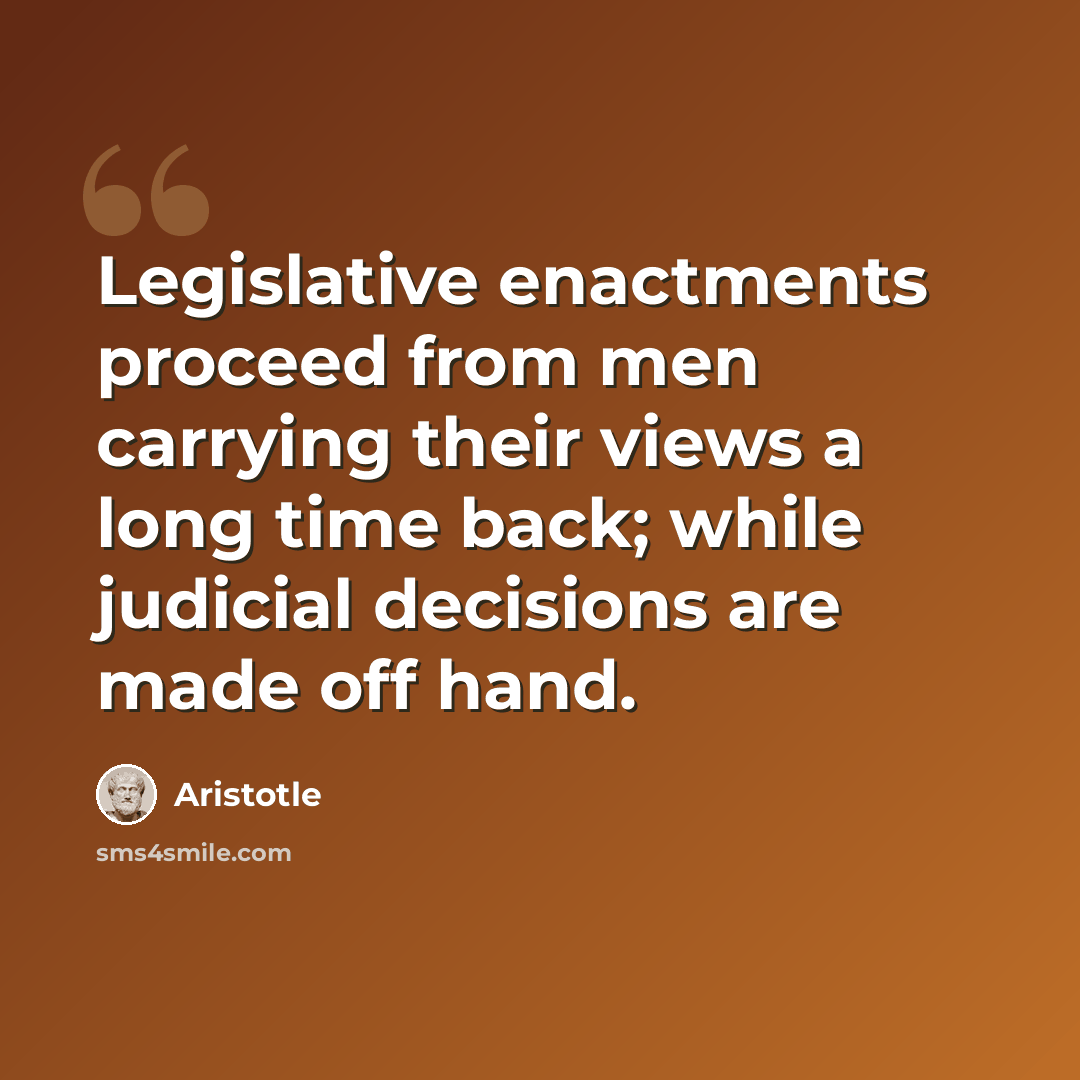
Legislative enactments proceed from men carrying their views a long time back; while judicial decisions are made off hand. — Aristotle Copy Share Image
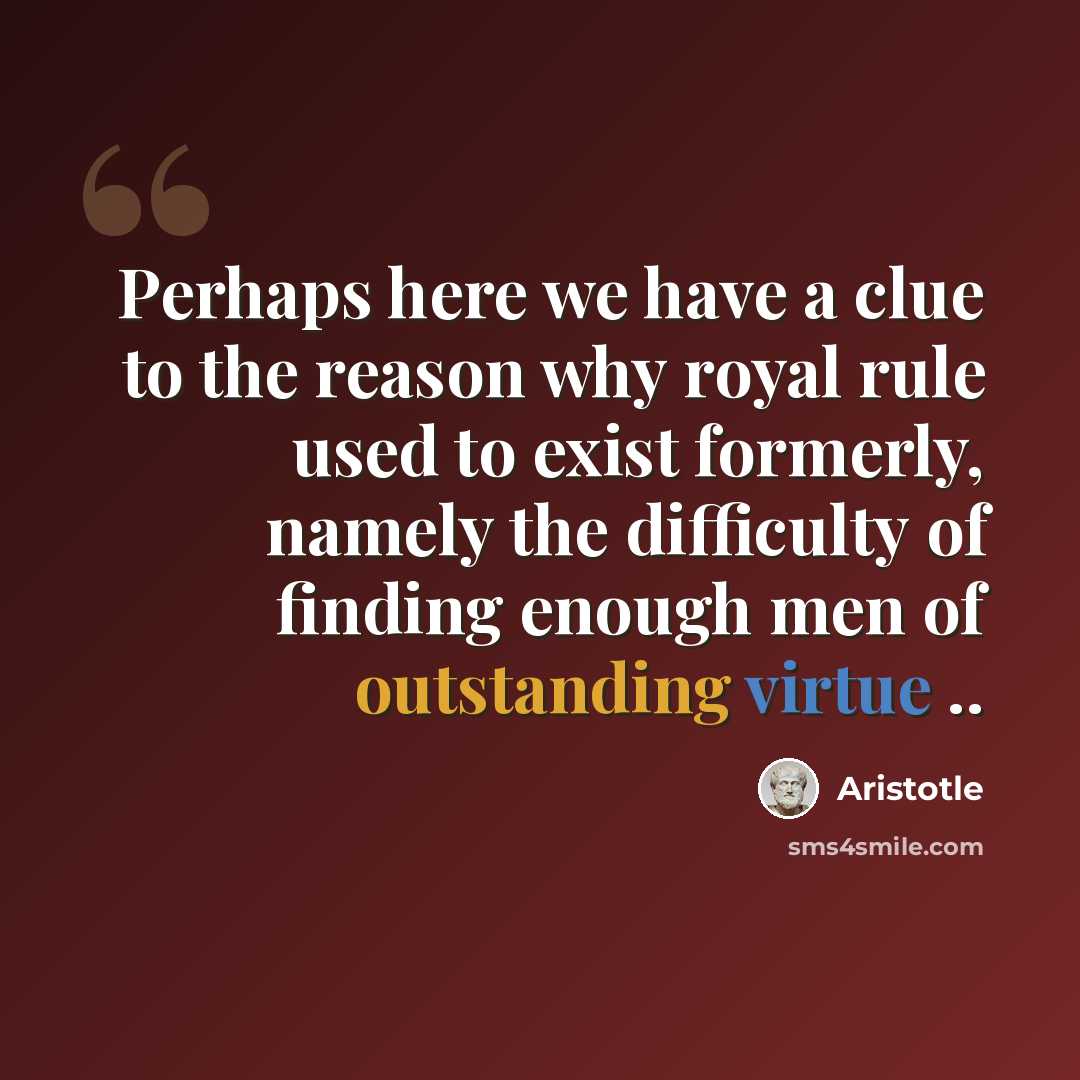
Perhaps here we have a clue to the reason why royal rule used to exist formerly, namely the difficulty of finding enough… — Aristotle Copy Share Image
The knowledge of the soul admittedly contributes greatly to the advance of truth in general, and, above all, to our understanding of Nature, for… — Aristotle Copy Share
Young men have strong passions and tend to gratify them indiscriminately. Of the bodily desires, it is the sexual by which they are most… — Aristotle Copy Share
The body is at its best between the ages of thirty and thirty-five; the mind is at its best about the age of forty-nine. — Aristotle Copy Share
The ensouled is distinguished from the unsouled by its being alive. Now since being alive is spoken of in many ways, even if only… — Aristotle Copy Share
Although it may be difficult in theory to know what is just and equal, the practical difficulty of inducing those to forbear who can,… — Aristotle Copy Share
The true forms of government, therefore, are those in which the one, or the few, or the many, govern with a view to the… — Aristotle Copy Share
All persons ought to endeavor to follow what is right, and not what is established. — Aristotle Copy Share
Give a man a fish, you feed him for a day. Give a man a poisoned fish, you feed him for the rest of… — Aristotle Copy Share
Obstinate people can be divided into the opinionated, the ignorant, and the boorish. — Aristotle Copy Share
Happiness does not consist in pastimes and amusements but in virtuous activities. — Aristotle Copy Share
To learn is a natural pleasure, not confined to philosophers, but common to all men. — Aristotle Copy Share