When couples have children in excess, let abortion be procured before sense and life have begun; what may or may not be… — Aristotle Copy Share Image
It concerns us to know the purposes we seek in life, for then, like archers aiming at a definite mark, we shall… — Aristotle Copy Share Image
Men create gods after their own image, not only with regard to their form but with regard to their mode of life. — Aristotle Copy Share Image
“He is happy who lives in accordance with complete virtue and is sufficiently equipped with external goods, not for some chance period… — Aristotle Copy Share Image
Politicians also have no leisure, because they are always aiming at something beyond political life itself, power and glory, or happiness. — Aristotle Copy Share Image
Since the things we do determine the character of life, no blessed person can become unhappy. For he will never do those… — Aristotle Copy Share Image
It is the activity of the intellect that constitutes complete human happiness - provided it be granted a complete span of life,… — Aristotle Copy Share Image
A good man may make the best even of poverty and disease, and the other ills of life; but he can only… — Aristotle Copy Share Image
...happiness does not consist in amusement. In fact, it would be strange if our end were amusement, and if we were to… — Aristotle Copy Share Image
“These are the three things—volume of sound, modulation of pitch, and rhythm—that a speaker bears in mind. It is those who do… — Aristotle Copy Share Image
The life of theoretical philosophy is the best and happiest a man can lead. Few men are capable of it and then… — Aristotle Copy Share Image
The wise man does not expose himself needlessly to danger, since there are few things for which he cares sufficiently; but he… — Aristotle Copy Share Image
Where your talents and the needs of the world cross, therein lies your vocation. These two, your talents and the needs of… — Aristotle Copy Share Image
“The happy life is thought to be one of excellence; now an excellent life requires exertion, and does not consist in amusement.… — Aristotle Copy Share Image
If what was said in the Ethics is true, that the happy life is the life according to virtue lived without impediment,… — Aristotle Copy Share Image
The soul is the cause or source of the living body. The terms cause and source have many senses. But the soul… — Aristotle Copy Share Image
Give a man a fish, you feed him for a day. Give a man a poisoned fish, you feed him for the… — Aristotle Copy Share Image
The happy life is regarded as a life in conformity with virtue. It is a life which involves effort and is not… — Aristotle Copy Share Image
“Virtue is a greater good than honour; and one might perhaps accordingly suppose that virtue rather than honour is the end of… — Aristotle Copy Share Image
The ultimate value of life depends upon awareness and the power of contemplation rather than upon mere survival. — Aristotle Copy Share Image
The happy life is thought to be one of excellence; now an excellent life requires exertion, and does not consist in amusement. — Aristotle Copy Share Image
The society that loses its grip on the past is in danger, for it produces men who know nothing but the present,… — Aristotle Copy Share Image
The life of money-making is one undertaken under compulsion, and wealth is evidently not the good we are seeking; for it is… — Aristotle Copy Share Image
These virtues are formed in man by his doing the actions ... The good of man is a working of the soul… — Aristotle Copy Share Image
Different men seek after happiness in different ways and by different means, and so make for themselves different modes of life and… — Aristotle Copy Share Image
Leisure of itself gives pleasure and happiness and enjoyment of life, which are experienced, not by the busy man, but by those… — Aristotle Copy Share Image
The state comes into existence for the sake of life and continues to exist for the sake of good life. — Aristotle Copy Share Image
If then it be possible that one contrary should exist, or be called into existence, the other contrary will also appear to… — Aristotle Copy Share Image
Remember that time slurs over everything, let all deeds fade, blurs all writings and kills all memories. Exempt are only those which… — Aristotle Copy Share Image
Those who educate children well are more to be honored than they who produce them; for these only gave them life, those… — Aristotle Copy Share Image
The good lawgiver should inquire how states and races of men and communities may participate in a good life, and in the… — Aristotle Copy Share Image
In poverty and other misfortunes of life, true friends are a sure refuge. The young they keep out of mischief; to the… — Aristotle Copy Share Image
If there is some end of the things we do, which we desire for its own sake, clearly this must be the… — Aristotle Copy Share Image
There is a cropping-time in the races of men, as in the fruits of the field; and sometimes, if the stock be… — Aristotle Copy Share Image
What is the highest good in all matters of action? To the name, there is almost complete agreement; for uneducated and educated… — Aristotle Copy Share Image
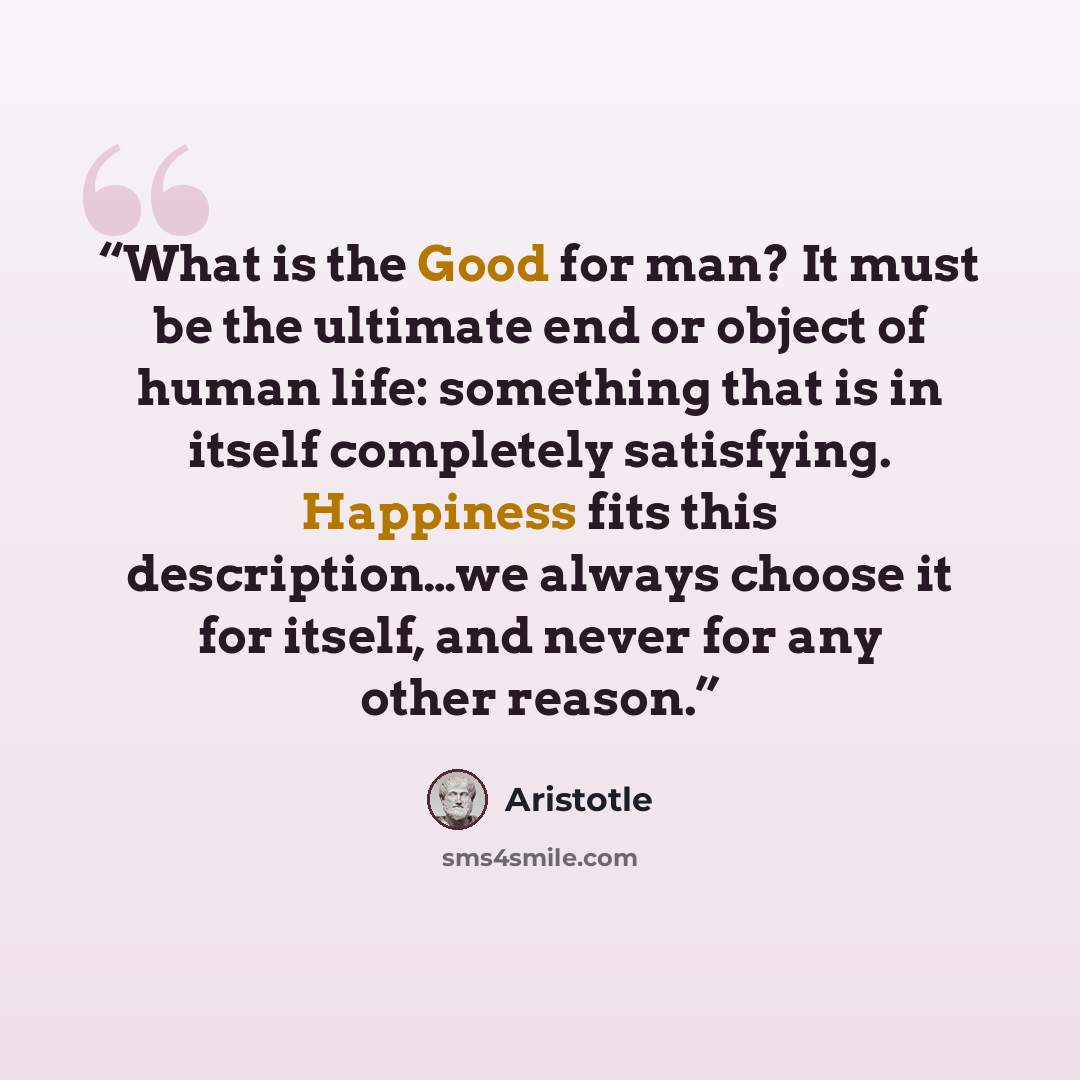
“What is the Good for man? It must be the ultimate end or object of human life: something that is in itself… — Aristotle Copy Share Image
The knowledge of the soul admittedly contributes greatly to the advance of truth in general, and, above all, to our understanding of Nature, for… — Aristotle Copy Share
Young men have strong passions and tend to gratify them indiscriminately. Of the bodily desires, it is the sexual by which they are most… — Aristotle Copy Share
The body is at its best between the ages of thirty and thirty-five; the mind is at its best about the age of forty-nine. — Aristotle Copy Share
The ensouled is distinguished from the unsouled by its being alive. Now since being alive is spoken of in many ways, even if only… — Aristotle Copy Share
Although it may be difficult in theory to know what is just and equal, the practical difficulty of inducing those to forbear who can,… — Aristotle Copy Share
The true forms of government, therefore, are those in which the one, or the few, or the many, govern with a view to the… — Aristotle Copy Share
All persons ought to endeavor to follow what is right, and not what is established. — Aristotle Copy Share
Give a man a fish, you feed him for a day. Give a man a poisoned fish, you feed him for the rest of… — Aristotle Copy Share
Obstinate people can be divided into the opinionated, the ignorant, and the boorish. — Aristotle Copy Share
Happiness does not consist in pastimes and amusements but in virtuous activities. — Aristotle Copy Share
To learn is a natural pleasure, not confined to philosophers, but common to all men. — Aristotle Copy Share