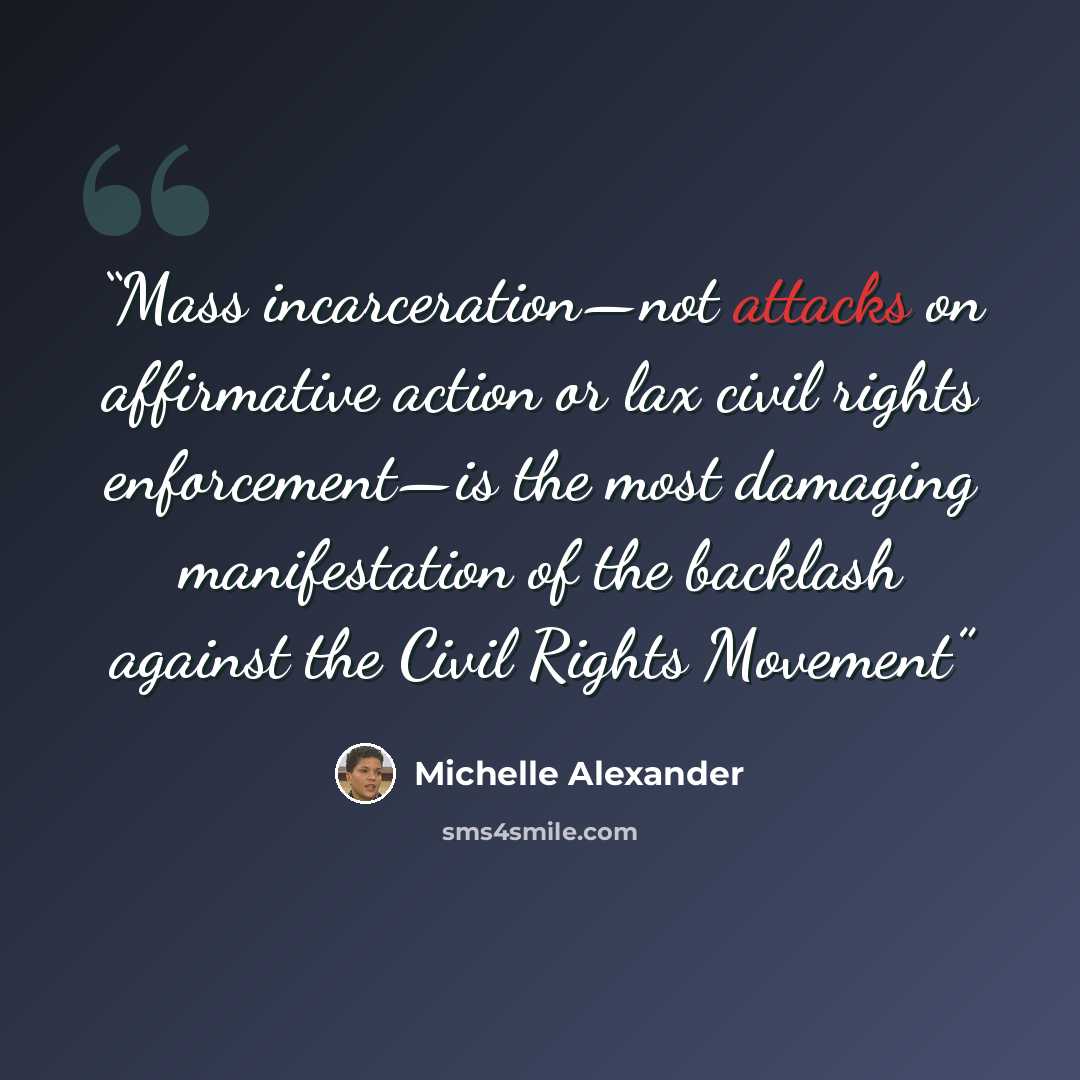
“Mass incarceration—not attacks on affirmative action or lax civil rights enforcement—is the most damaging manifestation of the backlash against the Civil Rights… — Michelle Alexander Copy Share Image
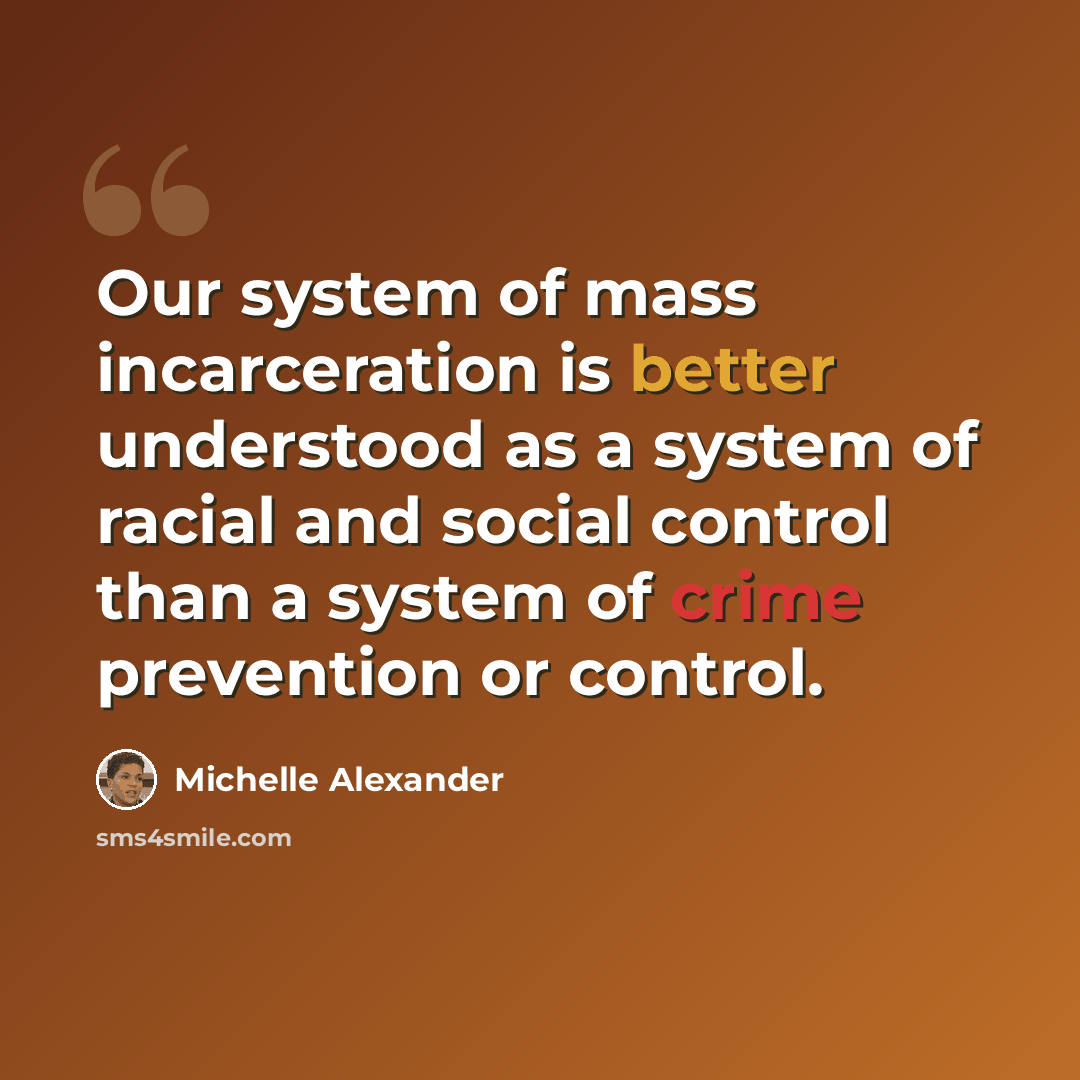
Our system of mass incarceration is better understood as a system of racial and social control than a system of crime prevention… — Michelle Alexander Copy Share Image
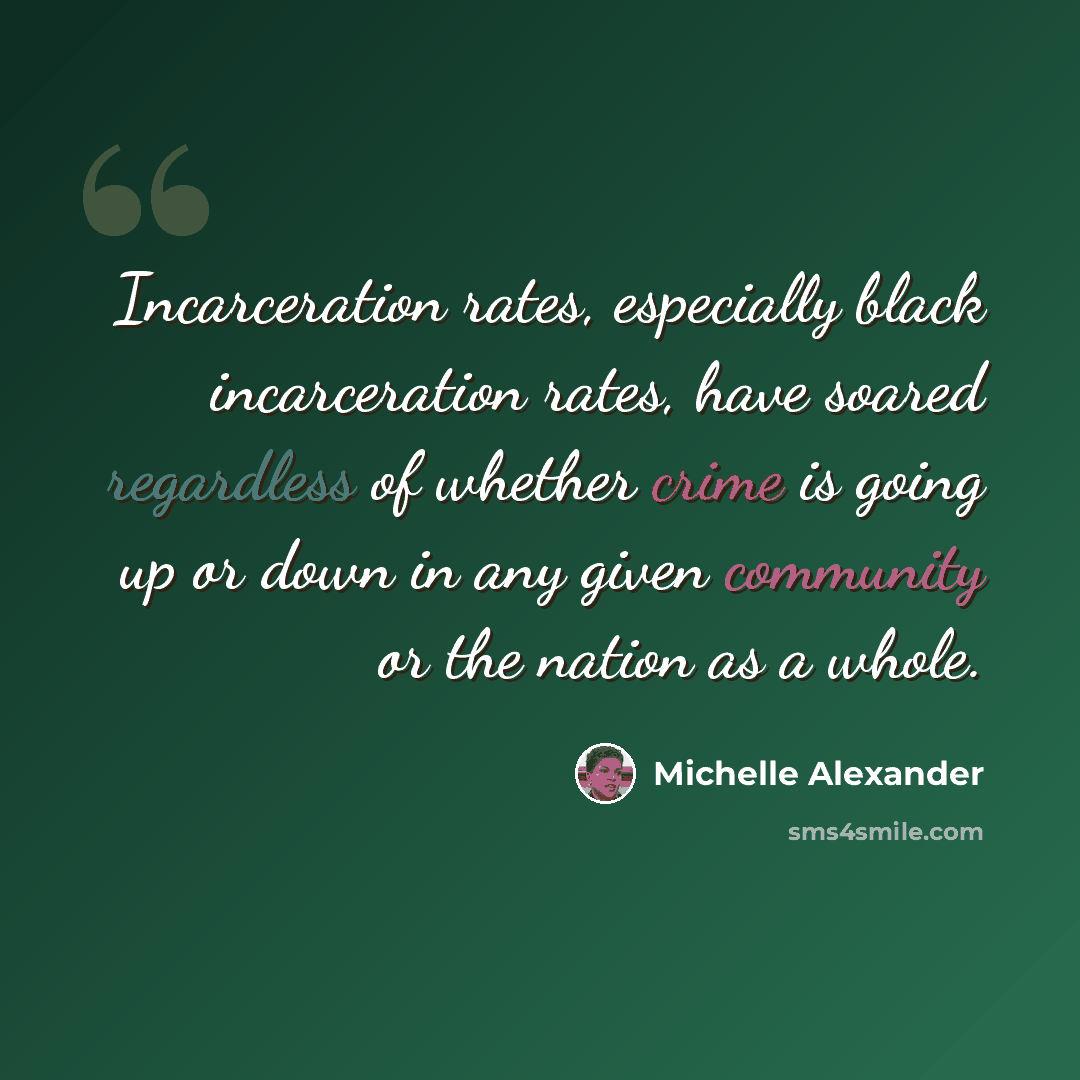
Incarceration rates, especially black incarceration rates, have soared regardless of whether crime is going up or down in any given community or… — Michelle Alexander Copy Share Image
We must build a movement for education, not incarceration. A movement for jobs, not jails. A movement that will end all forms… — Michelle Alexander Copy Share Image
“More African American adults are under correctional control today – in prison or jail, on probation or parole – than were enslaved… — Michelle Alexander Copy Share Image
“Historians will likely wonder how we could describe the new caste system as a system of crime control, when it is difficult… — Michelle Alexander Copy Share Image
In many large urban areas, the majority of working age African American men now have criminal records and are thus subject to… — Michelle Alexander Copy Share Image
For those interested in learning more about corporations and private individuals profiting from the caging of human beings, I highly recommend the… — Michelle Alexander Copy Share Image
The war on drugs has been the engine of mass incarceration. Drug convictions alone constituted about two-thirds of the increase in the… — Michelle Alexander Copy Share Image
The United States does have the highest rate of incarceration in the world dwarfing the rates of even highly repressive regimes like… — Michelle Alexander Copy Share Image
If we continue to tell ourselves the popular myths about racial progress or, worse yet, if we say to ourselves that the… — Michelle Alexander Copy Share Image
“As law enforcement budgets exploded, so did prison and jail populations. In 1991, the Sentencing Project reported that the number of people… — Michelle Alexander Copy Share Image
I believe this system of mass incarceration would have Dr. King turning in his grave. There's no doubt in my mind that… — Michelle Alexander Copy Share Image
The United States imprisons a larger percentage of its black population than South Africa did at the height of apartheid. In Washington,… — Michelle Alexander Copy Share Image
After the end of slavery, African-American men were arrested in mass, and they were arrested for extremely minor crimes like loitering, standing… — Michelle Alexander Copy Share Image
Eventually [black men] are arrested, whether they've committed any serious crime or not, and branded criminals or felons for life. Upon release,… — Michelle Alexander Copy Share Image
“The state of Mississippi eventually moved from hiring convict labor to organizing its own convict labor camp, known as Parchman Farm. It… — Michelle Alexander Copy Share Image
Arguably the most important parallel between mass incarceration and Jim Crow is that both have served to define the meaning and significance… — Michelle Alexander Copy Share Image
We're foolish if we think we're going to end mass incarceration unless we are willing to deal with the reality that huge… — Michelle Alexander Copy Share Image
“Far from fading away, it appears that prisons are here to stay. And despite the unprecedented levels of incarceration in the African… — Michelle Alexander Copy Share Image
“More African American adults are under correctional control today - in prison or jail, on probation or parole - than were enslaved… — Michelle Alexander Copy Share Image
“Although a million black men can be found in prisons and jails, public acknowledgment of the role of the criminal justice system… — Michelle Alexander Copy Share Image
“In order to make this point, we need to talk about race openly and honestly. We must stop debating crime policy as… — Michelle Alexander Copy Share Image
In a sense, mass incarceration has emerged as a far more extreme form of physical and residential segregation than Jim Crow segregation.… — Michelle Alexander Copy Share Image
In my view, the critical questions in this era of mass incarceration are: What disturbs us? What seems contrary to expectation? Who… — Michelle Alexander Copy Share Image
I believe it is possible to bring an end to mass incarceration and birth a new moral consensus about how we ought… — Michelle Alexander Copy Share Image
“As a society, our decision to heap shame and contempt upon those who struggle and fail in a system designed to keep… — Michelle Alexander Copy Share Image
“And despite the unprecedented levels of incarceration in the African American community, the civil rights community is oddly quiet.” — Michelle Alexander Copy Share Image
“This book argues that mass incarceration is, metaphorically, the New Jim Crow and that all those who care about social justice should… — Michelle Alexander Copy Share Image
Today mass incarceration defines the meaning of blackness in America: Black people, especially black men, are criminals. That is what it means… — Michelle Alexander Copy Share Image
“Racial violence has been rationalized, legitimated, and channeled through our criminal justice system; it is expressed as police brutality, solitary confinement, and… — Michelle Alexander Copy Share Image
The criminal justice system was strategically employed to force African Americans back into a system of extreme repression and control, a tactic… — Michelle Alexander Copy Share Image
My experience and research has led me to the regrettable conclusion that our system of mass incarceration functions more like a caste… — Michelle Alexander Copy Share Image
The mass incarceration of poor people of color, particularly black men, has emerged as a new caste system, one specifically designed to… — Michelle Alexander Copy Share Image
“Ninety percent of those admitted to prison for drug offenses in many states were black or Latino, yet the mass incarceration of… — Michelle Alexander Copy Share Image
If you take into account prisoners, a large majority of African American men in some urban areas, like Chicago, have been labeled… — Michelle Alexander Copy Share Image
“We should ask ourselves whether efforts to achieve "cosmetic" racial diversity- that is, reform efforts that make institutions look good on the… — Michelle Alexander Copy Share Image
There is a tremendous amount of confusion and denial that exists about mass incarceration today, and that is the biggest barrier to… — Michelle Alexander Copy Share Image
The fact that more than half of the young black men in any large American city are currently under the control of… — Michelle Alexander Copy Share Image
The system functioned relatively automatically, and the prevailing system of racial meanings, identities, and ideologies already seemed natural. Ninety percent of those… — Michelle Alexander Copy Share Image
If you ask for good schools, you aren't likely to get them. If you ask for jobs or economic investment, you won't get that… — Michelle Alexander Copy Share
The uncomfortable reality we must face is that California, like the nation as a whole, has treated generations of African Americans and Latinos as… — Michelle Alexander Copy Share
“Seeing race is not the problem. Refusing to care for the people we see is the problem. The fact that the meaning of race… — Michelle Alexander Copy Share
Since the nations founding, African Americans repeatedly have been controlled through institutions such as slavery and Jim Crow, which appear to die but then… — Michelle Alexander Copy Share
“Felon disenfranchisement laws have been more effective in eliminating black voters in the age of mass incarceration than they were under Jim Crow…These figures… — Michelle Alexander Copy Share
“That was King’s dream—a society that is capable of seeing each of us, as we are, with love. That is a goal worth fighting… — Michelle Alexander Copy Share
Activists take the risks, while advocates are professional tinkerers with the system. What's necessary is for those who are advocates to support those who… — Michelle Alexander Copy Share
“Civil rights protests were frequently depicted as criminal rather than political in nature, and federal courts were accused of excessive “lenience” toward lawlessness, thereby… — Michelle Alexander Copy Share
We cannot 'fix' the police without a revolution of values and radical change to the basic structure of our society. — Michelle Alexander Copy Share
If we continue to tell ourselves the popular myths about racial progress or, worse yet, if we say to ourselves that the problem of… — Michelle Alexander Copy Share
The mass incarceration of poor people of color, particularly black men, has emerged as a new caste system, one specifically designed to address the… — Michelle Alexander Copy Share
“[T]he slave went free; stood a brief moment in the sun; then moved back again toward slavery. —W.E.B Du Bois, Black Reconstruction in America… — Michelle Alexander Copy Share
If you take into account prisoners, a large majority of African American men in some urban areas, like Chicago, have been labeled felons for… — Michelle Alexander Copy Share
“A new civil rights movement cannot be organized around the relics of the earlier system of control if it is to address meaningfully the… — Michelle Alexander Copy Share
The rules and reasons the political system employs to enforce status relations of any kind, including racial hierarchy, evolve and change as they are… — Michelle Alexander Copy Share
![“Eventually [black men] are arrested, whether they've committed any serious crime or not, and branded criminals or felons for life. Upon release, they're ushered into a parallel social universe in which the civil and human rights supposedly won during the Civil Rights Movement no longer apply to…” quote by Michelle Alexander](https://sms4smile.com/q/img-quotes/b57/michelle-alexander-750_arrested_eventually-black-men-are-arrested-whethe_348081.png)