We mostly don't get sick. Most often, bacteria are keeping us well. — Bonnie Bassler Copy Share Image
Biocides, for example, are designed to kill bacteria—it's not a benign material. — William Stringfellow Copy Share Image
Biology will relate every human gene to the genes of other animals and bacteria, to this great chain of being. — Walter Gilbert Copy Share Image
Everyone is trying to jump on the biomimic bandwagon. But a cork floor is not biomimicry. Neither is using bacteria to clean… — Janine Benyus Copy Share Image
Our bodies are home to trillions of microbes, and these creatures define who we are. — Jessica Green Copy Share Image
For the first half of geological time our ancestors were bacteria. Most creatures still are bacteria, and each one of our trillions… — Richard Dawkins Copy Share Image
The oil acts like a cleanser. When you put it in your mouth and work it around your teeth and gums it… — Bruce Fife Copy Share Image
What's great about bacteria is you have a surprise every day waiting for you because they're so fast, they grow overnight. — Bonnie Bassler Copy Share Image
“We’re organisms; we’re conceived, we’re born, we live, we die, and we decay. But as we decay we feed the world of… — Bill Bass Copy Share Image
You cannot insert a gene you took from a bacteria into a seed and call it LIFE. You have not created life,… — Vandana Shiva Copy Share Image
“People are like germs, only bigger. That bit of wisdom has proven true, for the most part. Humans are little more than… — Mike Duran Copy Share Image
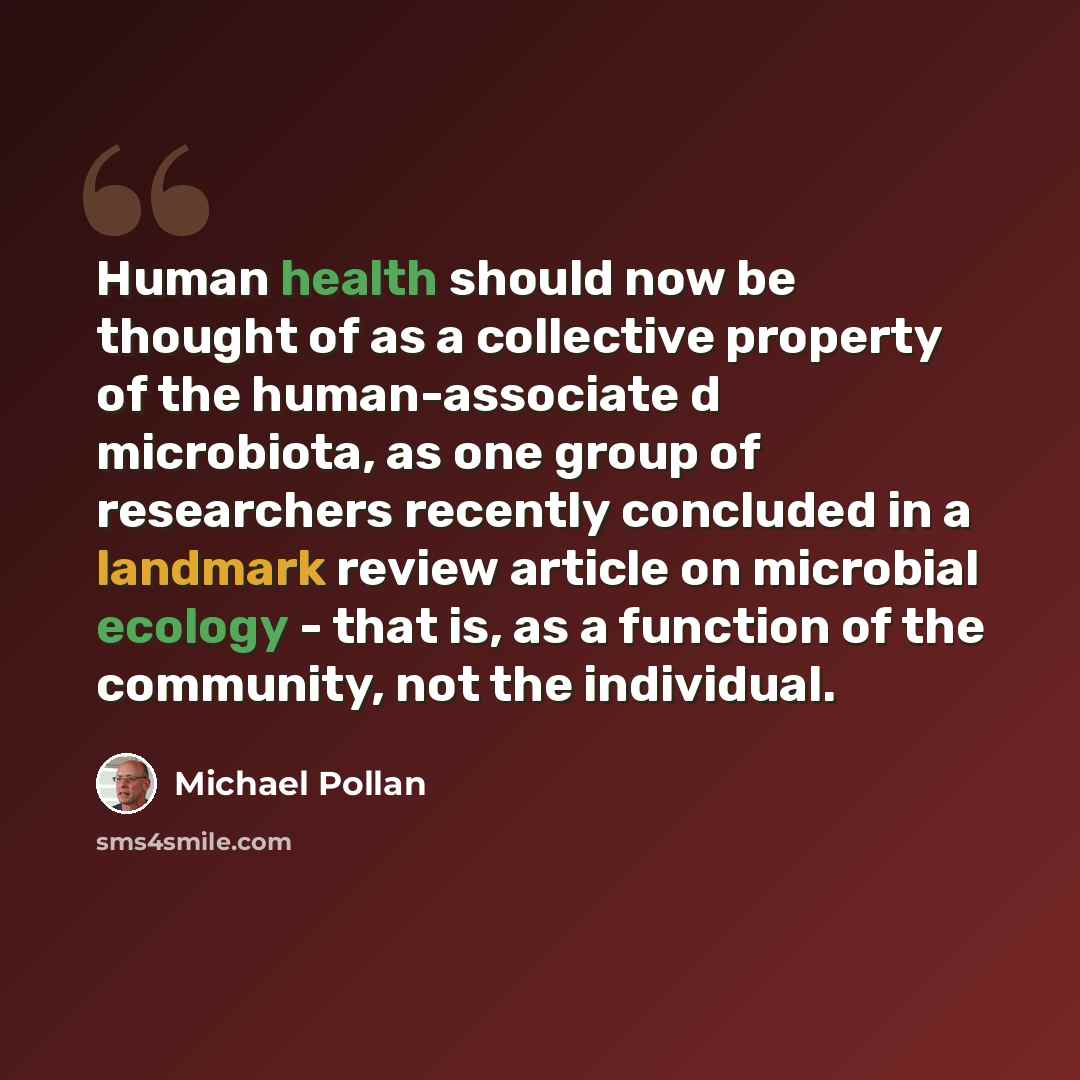
Human health should now be thought of as a collective property of the human-associate d microbiota, as one group of researchers recently… — Michael Pollan Copy Share Image
Each of these [bacterial] species are masterpieces of evolution. Each has persisted for thousands to millions of years. Each is exquisitely adapted… — E. O. Wilson Copy Share Image
“So why, you are bound to ask at some point in your life, do microbes so often want to hurt us? What… — Bill Bryson Copy Share Image
We still think of human disease as the work of an organized, modernized kind of demonology, in which the bacteria are the… — Lewis Thomas Copy Share Image
The usual way of growing cotton is highly petrochemical-intensive, requiring 110 pounds of nitrogen fertilizer per acre. Some of the fertilizer is… — Alex Shoumatoff Copy Share Image
There's very little that shocks me because I consider life a miracle so I guess what shocks me is that life exists.… — Bernie Siegel Copy Share Image
“Biologists discovered the microbiome just over the past couple of decades. They are still puzzling out how the microbes in your body… — Bill Nye Copy Share Image
“Consider the difference in size between some of the very tiniest and the very largest creatures on Earth. A small bacterium weights… — Laurie Garrett Copy Share Image
“York from a Dutch neighbor who had immigrated from Java.” People living in the warm East Indian climate noticed that birds gathered… — Anne E. Maczulak Copy Share Image
What we want is another sample of life, which is not on our tree of life at all. All life that we've… — Paul Davies Copy Share Image
“nine of every ten cells in our bodies belong not to us, but to these microbial species (most of them residents of… — Michael Pollan Copy Share Image
It has taken biologists some 230 years to identify and describe three quarters of a million insects; if there are indeed at… — Richard Leakey Copy Share Image
“Drinking lots of alcohol makes the gut leakier, allowing microbes to more readily influence the brain. Could that help to explain why… — Ed Yong Copy Share Image
If we recognise that every ecosystem can also be viewed as a food web, we can think of it as a circular,… — Murray Bookchin Copy Share Image
I think that we reject the evidence that our world is changing because we are still, as that wonderfully wise biologist E.… — James Lovelock Copy Share Image
“This is a miracle of coevolution—the bacteria that coexist with us in our bodies enable us to exist. Microbiologist Michael Wilson notes… — Sandor Ellix Katz Copy Share Image
“We inherit every one of our genes, but we leave the womb without a single microbe. As we pass through our mother's… — Michael Specter Copy Share Image
“Dr. Richard Selzer is a surgeon and a favorite author of mine. He writes the most beautiful and compassionate descriptions of his… — James C. Dobson Copy Share Image
“The Greek word for kernel is karys, so the word used to describe creatures without a nucleus is prokaryotic—the name, originally procariotique,… — William Rosen Copy Share Image
“Most animals can't tap into these open-source adaptations deliberately. The flies didn't seek out Spiroplasma to solve their worm problem. Woodrats didn't… — Ed Yong Copy Share Image
“Of course I'd long known that I was playing host to a massive collection of parasitic organisms, but I didn't much like… — John Green Copy Share Image
“When Hamiltonella's genome was sequenced, the real reason behind the bacterium's protective powers became apparent: about half of its DNA actually belonged… — Ed Yong Copy Share Image
“We may not like thinking about it, but germs crawl eternally over every speck of our planet. Our own bodies are bacterial… — Barbara Kingsolver Copy Share Image
![“Each of these [bacterial] species are masterpieces of evolution. Each has persisted for thousands to millions of years. Each is exquisitely adapted to the environment in which it lives, interlocked with other species to form ecosystems upon which our own lives depend in ways we have not begun even…” quote by E. O. Wilson](https://sms4smile.com/q/img-quotes/7bf/e-o-wilson-1348_adapted_each-of-these-bacterial-species-are-mast_1047978.jpg)