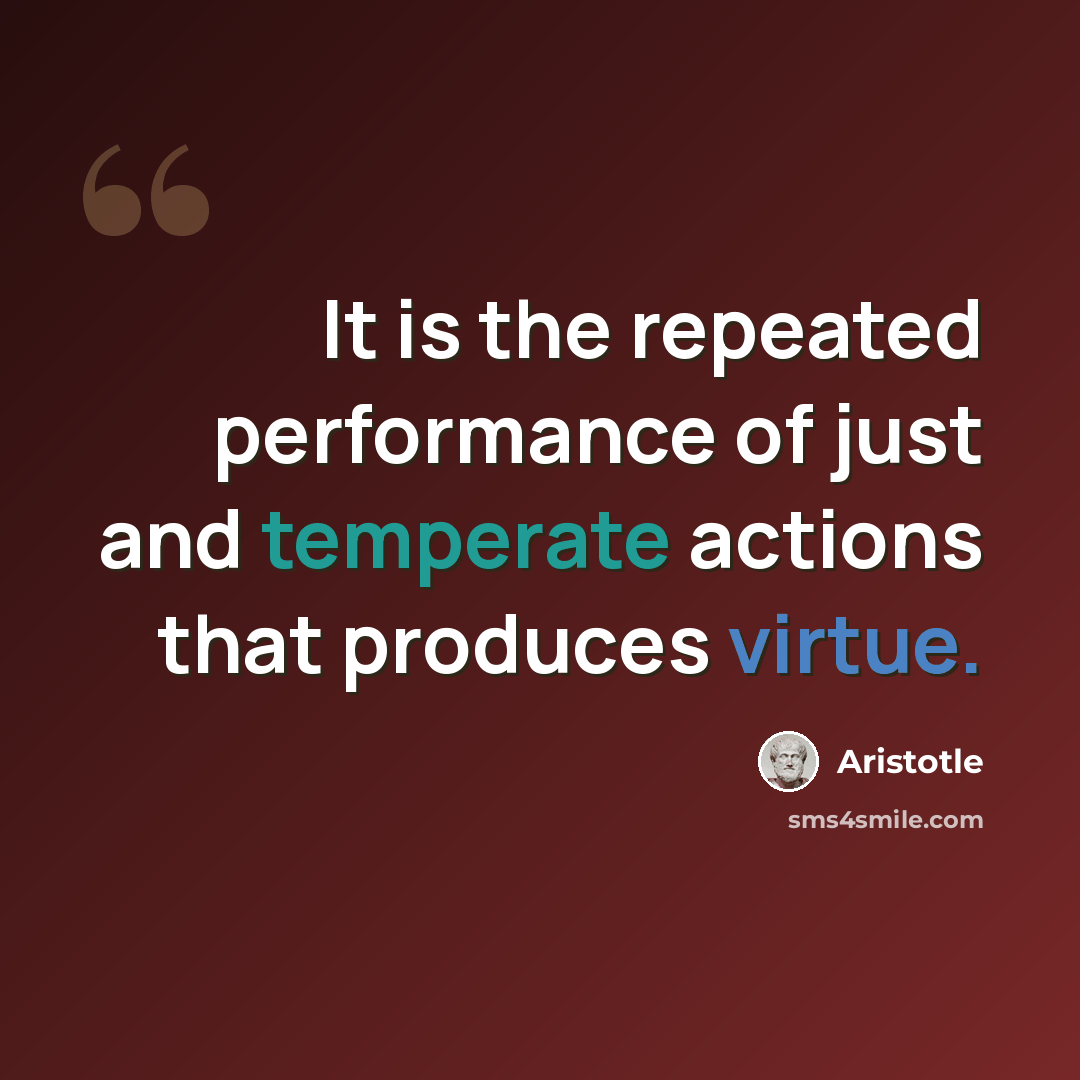
It is the repeated performance of just and temperate actions that produces virtue. — Aristotle Copy Share Image
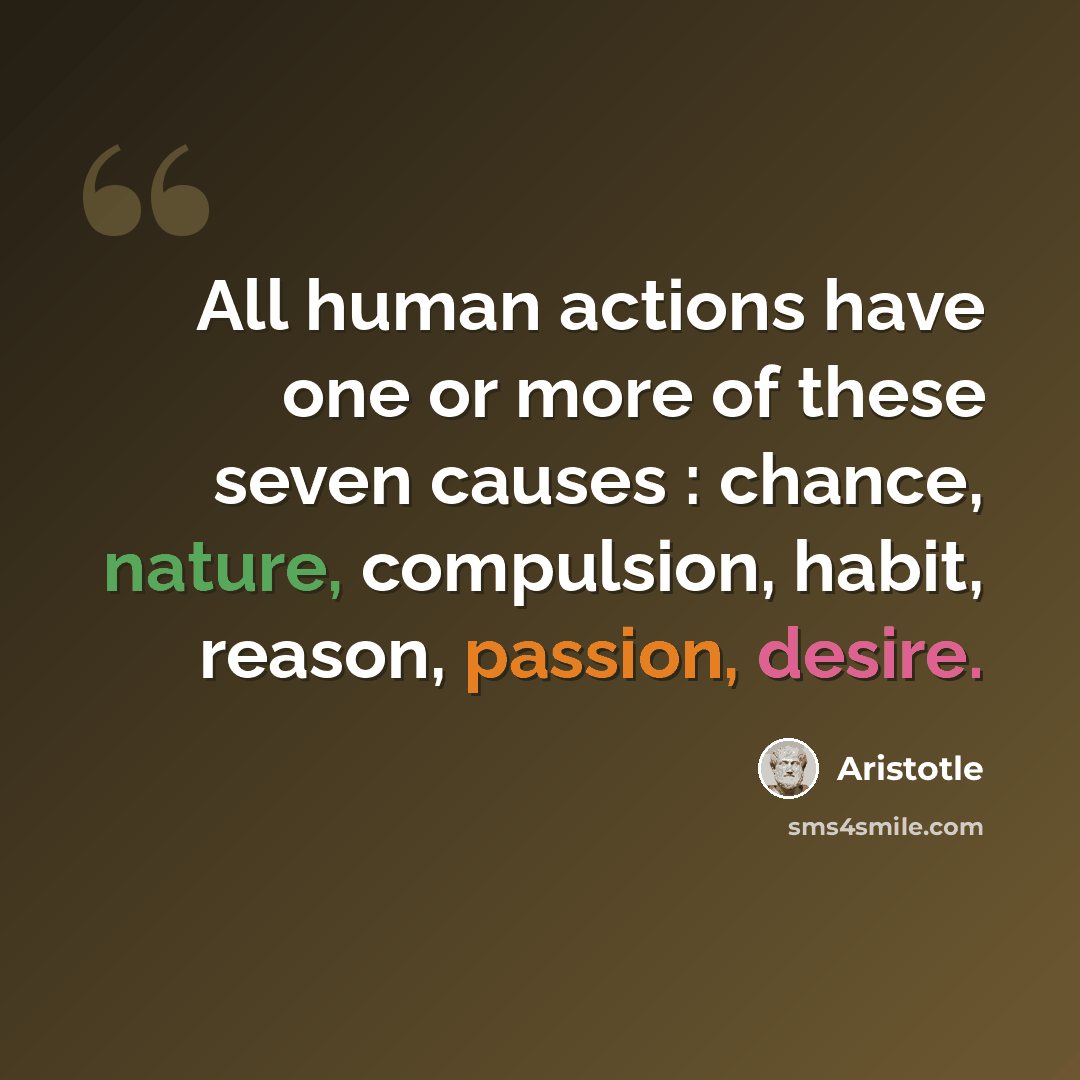
All human actions have one or more of these seven causes : chance, nature, compulsion, habit, reason, passion, desire. — Aristotle Copy Share Image
. . . Political society exists for the sake of noble actions, and not of mere companionship. — Aristotle Copy Share Image
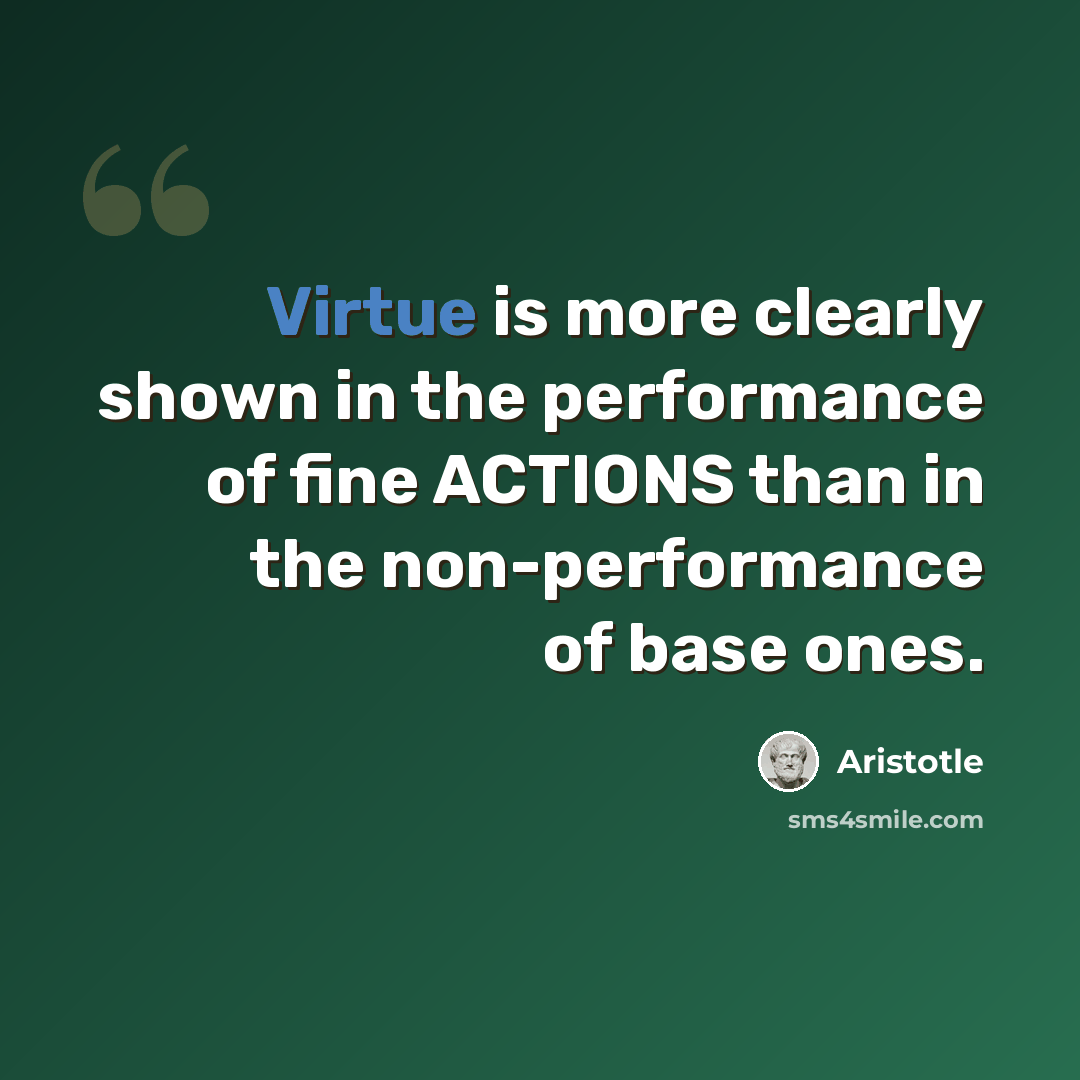
Virtue is more clearly shown in the performance of fine ACTIONS than in the non-performance of base ones. — Aristotle Copy Share Image
Everything that depends on the action of nature is by nature as good as it can be. — Aristotle Copy Share Image
We are the sum of our actions, and therefore our habits make all the difference. — Aristotle Copy Share Image
Character gives us qualities, but it is in our actions — what we do — that we are happy or the reverse. — Aristotle Copy Share Image
Some vices miss what is right because they are deficient, others because they are excessive, in feelings or in actions, while virtue… — Aristotle Copy Share Image
A state is not a mere society, having a common place, established for the prevention of mutual crime and for the sake… — Aristotle Copy Share Image
What is the highest of all goods achievable by action? ...both the general run of man and people of superior refinement say… — Aristotle Copy Share Image
Friends are an aid to the young, to guard them from error; to the elderly, to attend to their wants and to… — Aristotle Copy Share Image
Thus every action must be due to one or other of seven causes: chance, nature, compulsion, habit, reasoning, anger, or appetite. — Aristotle Copy Share Image
A tragedy is the imitation of an action that is serious and also, as having magnitude, complete in itself . . .… — Aristotle Copy Share Image
Men acquire a particular quality by constantly acting a particular way. You become just by performing just actions, temperate by performing temperate… — Aristotle Copy Share Image
Character gives us qualities, but it is in actions - what we do - that we are happy or the reverse. ...… — Aristotle Copy Share Image
[Prudence] is the virtue of that part of the intellect [the calculative] to which it belongs; and . . . our choice… — Aristotle Copy Share Image
The virtue of a faculty is related to the special function which that faculty performs. Now there are three elements in the… — Aristotle Copy Share Image
Whatever we learn to do, we learn by actually doing it; men come to be builders, for instance, by building, and harp… — Aristotle Copy Share Image
We are masters of our actions from the beginning up to the very end. But, in the case of our habits, we… — Aristotle Copy Share Image
Even when laws have been written down, they ought not always to remain unaltered. As in other sciences, so in politics, it… — Aristotle Copy Share Image
Tyrants preserve themselves by sowing fear and mistrust among the citizens by means of spies, by distracting them with foreign wars, by… — Aristotle Copy Share Image
The purpose of the present study is not as it is in other inquiries, the attainment of knowledge, we are not conducting… — Aristotle Copy Share Image
Nature herself, as has been often said, requires that we should be able, not only to work well, but to use leisure… — Aristotle Copy Share Image
The honors and rewards fall to those who show their good qualities in action. — Aristotle Copy Share Image
It is easy to perform a good action, but not easy to acquire a settled habit of performing such actions. — Aristotle Copy Share Image
A speaker who is attempting to move people to thought or action must concern himself with Pathos. — Aristotle Copy Share Image
Indeed, we may go further and assert that anyone who does not delight in fine actions is not even a good man. — Aristotle Copy Share Image
Pleasure causes us to do base actions and pain causes us to abstain from doing noble actions. — Aristotle Copy Share Image
Every art and every inquiry, and similarly every action and choice, is thought to aim at some good; and for this reason… — Aristotle Copy Share Image
These virtues are formed in man by his doing the actions ... The good of man is a working of the soul… — Aristotle Copy Share Image
Everything that depends on the action of nature is by nature as good as it can be, and similarly everything that depends… — Aristotle Copy Share Image
“It is well said, then, that it is by doing just acts that the just man is produced, and by doing temperate… — Aristotle Copy Share Image
In cases of this sort, let us say adultery, rightness and wrongness do not depend on committing it with the right woman… — Aristotle Copy Share Image
If, therefore, there is any one superior in virtue and in the power of performing the best actions, him we ought to… — Aristotle Copy Share Image
If then, as we say, good craftsmen look to the mean as they work, and if virtue, like nature, is more accurate… — Aristotle Copy Share Image
What is the highest good in all matters of action? To the name, there is almost complete agreement; for uneducated and educated… — Aristotle Copy Share Image
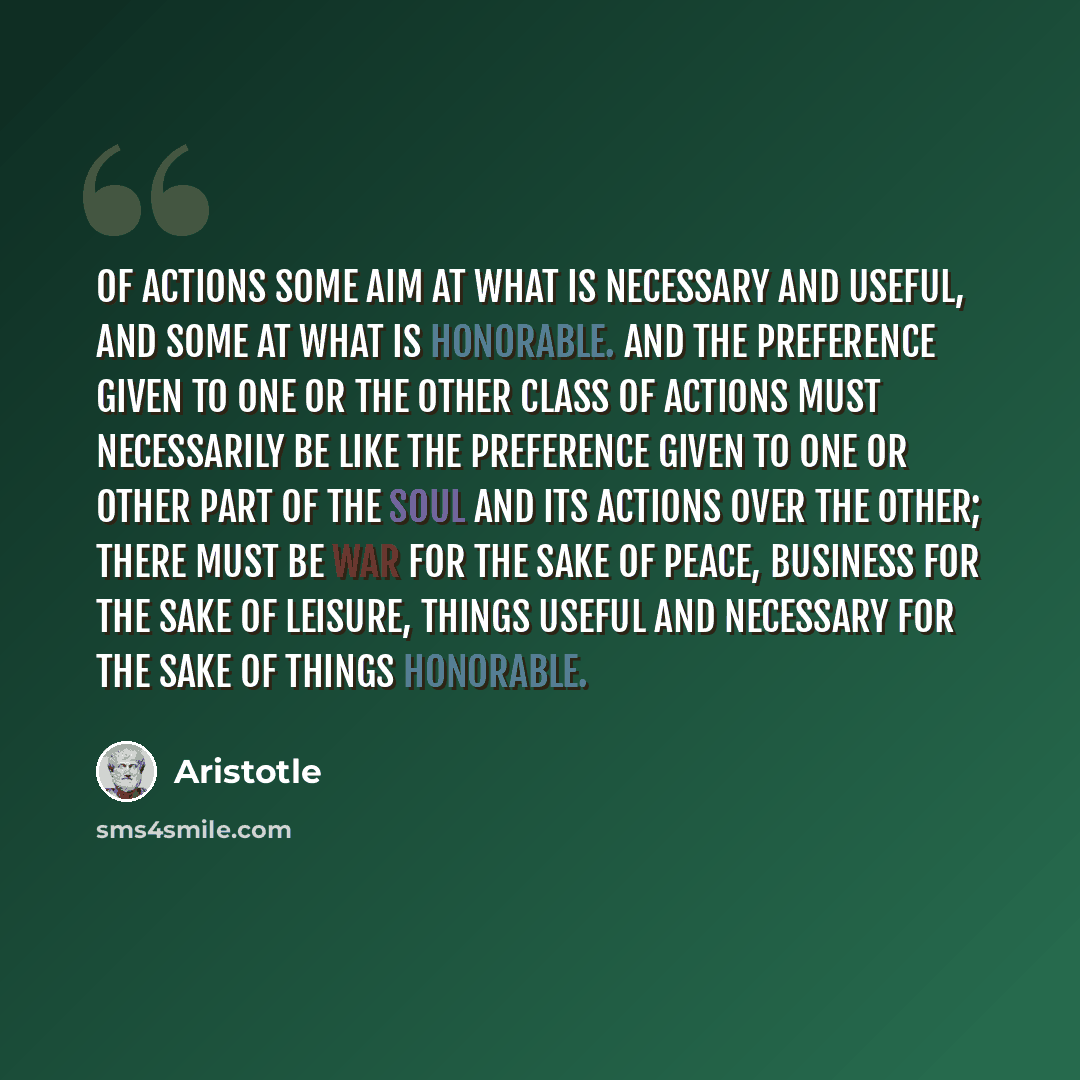
Of actions some aim at what is necessary and useful, and some at what is honorable. And the preference given to one… — Aristotle Copy Share Image
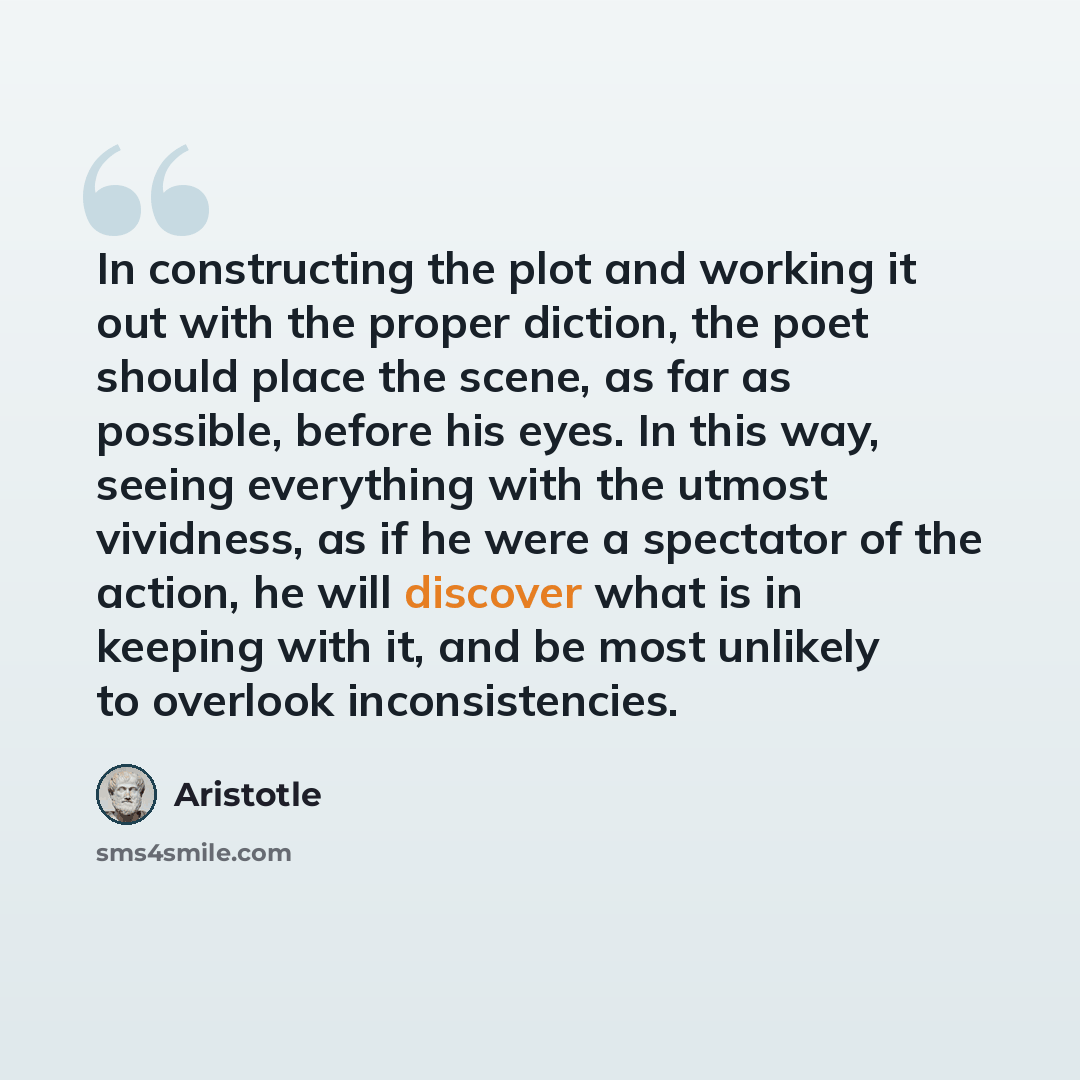
In constructing the plot and working it out with the proper diction, the poet should place the scene, as far as possible,… — Aristotle Copy Share Image
The knowledge of the soul admittedly contributes greatly to the advance of truth in general, and, above all, to our understanding of Nature, for… — Aristotle Copy Share
Young men have strong passions and tend to gratify them indiscriminately. Of the bodily desires, it is the sexual by which they are most… — Aristotle Copy Share
The body is at its best between the ages of thirty and thirty-five; the mind is at its best about the age of forty-nine. — Aristotle Copy Share
The ensouled is distinguished from the unsouled by its being alive. Now since being alive is spoken of in many ways, even if only… — Aristotle Copy Share
Although it may be difficult in theory to know what is just and equal, the practical difficulty of inducing those to forbear who can,… — Aristotle Copy Share
The true forms of government, therefore, are those in which the one, or the few, or the many, govern with a view to the… — Aristotle Copy Share
All persons ought to endeavor to follow what is right, and not what is established. — Aristotle Copy Share
Give a man a fish, you feed him for a day. Give a man a poisoned fish, you feed him for the rest of… — Aristotle Copy Share
Obstinate people can be divided into the opinionated, the ignorant, and the boorish. — Aristotle Copy Share
Happiness does not consist in pastimes and amusements but in virtuous activities. — Aristotle Copy Share
To learn is a natural pleasure, not confined to philosophers, but common to all men. — Aristotle Copy Share


![“[Prudence] is the virtue of that part of the intellect [the calculative] to which it belongs; and . . . our choice of actions will not be right without Prudence any more than without Moral Virtue, since, while Moral Virtue enables us to achieve the end, Prudence makes us adopt the right means to…” quote by Aristotle](https://sms4smile.com/q/img-quotes/be1/aristotle-78_achieve_prudence-is-the-virtue-of-that-part-of-t_431676.jpg)

![“If then, as we say, good craftsmen look to the mean as they work, and if virtue, like nature, is more accurate and better than any form of art, it will follow that virtue has the quality of hitting the mean. I refer to moral virtue [not intellectual], for this is concerned with emotions and…” quote by Aristotle](https://sms4smile.com/q/img-quotes/796/aristotle-78_accurate_if-then-as-we-say-good-craftsmen-look-to_695282.jpg)